








Water taps are an essential part of every home, but choosing the right tap is not always as simple as it seems. From traditional pillar taps and bib taps to modern mixer, sensor, pull-out, and wall-mounted taps, there are many options available for different applications. Each type offers different benefits in terms of design, water flow, installation, convenience, and durability.
Understanding the different types of water taps can help homeowners, architects, contractors, and businesses choose the right product for kitchens, bathrooms, wash basins, utility areas, gardens, and other spaces. At the Moglix business, you can procure bathroom fittings and sanitary ware products in bulk at the most reasonable prices.
This guide explains 15 types of water taps, their uses, features, advantages, and key factors to consider before making a purchase.
What Are Water Taps?
A water tap is a plumbing fixture used to control and regulate the flow of water from a supply pipe. Depending on its design, a tap may control hot water, cold water, or both. Modern taps and faucets are available in different configurations, materials, finishes, and operating mechanisms.
The right water tap depends on various factors, including installation location, water pressure, plumbing configuration, frequency of use, available space, design preference, and budget.
Also read: How To Fix A Leaky Faucet in 10 Easy Steps (2026 Complete Guide)
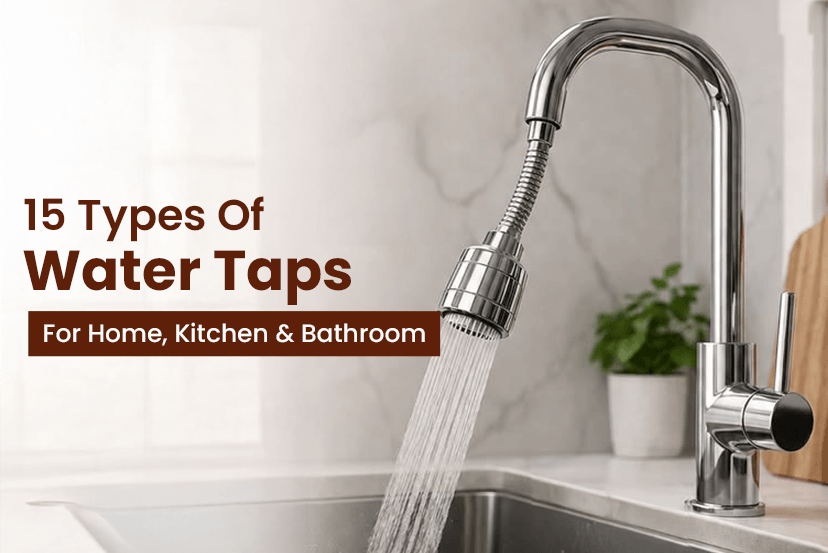
15 Types of Water Taps for Home, Kitchen & Bathroom
Here are some of the most commonly used water tap types for residential and commercial applications.
1. Pillar Taps
Pillar taps are among the most common and traditional types of water taps. They are generally installed as a pair, with one tap supplying hot water and the other supplying cold water. These taps are commonly used with wash basins and bathroom sinks. Their straightforward design makes them relatively easy to install and maintain.
Best for: Bathrooms, wash basins, and traditional plumbing systems.
Key benefits:
- Simple design
- Easy operation
- Available in different finishes
- Suitable for separate hot and cold water supplies
Also read: Top 10 Sanitary Ware And Bathroom Fittings Brands In India 2026
2. Bib Taps
Bib taps, also known as bibcocks, are widely used for general water supply applications. They typically have a horizontal outlet and are installed directly onto a wall or pipe connection.
They are commonly found in utility areas, gardens, garages, bathrooms, and outdoor spaces.
Best for: Garden, utility, and general-purpose water connections.
Key benefits:
- Simple construction
- Easy to operate
- Suitable for outdoor applications
- Available with hose-compatible outlets
3. Mixer Taps
Mixer taps combine hot and cold water through a single outlet. The user can adjust the temperature by controlling the hot and cold water flow.
Mixer taps are particularly popular in kitchens and bathrooms because they provide greater convenience than separate hot and cold taps.
Best for: Kitchen sinks, bathroom basins, and utility areas.
Key benefits:
- Combines hot and cold water
- Convenient temperature control
- Modern appearance
- Available in various designs
4. Monobloc Taps
Monobloc taps are a type of mixer tap installed through a single mounting hole. They typically feature a single lever that controls both water flow and temperature.
Their compact configuration makes them suitable for modern kitchen sinks and bathroom basins.
Best for: Modern kitchens and countertop wash basins.
Key benefits:
- Single-hole installation
- Easy temperature adjustment
- Contemporary design
- Convenient one-handed operation
5. Wall-Mounted Taps
Wall-mounted taps are fixed directly to the wall instead of being installed on the basin or countertop. They can create a clean and uncluttered appearance.
These taps are commonly used in bathrooms, kitchens, wash areas, and commercial spaces.
Best for: Wall-mounted basins, bathrooms, and modern kitchens.
Key benefits:
- Saves countertop space
- Easy-to-clean surrounding area
- Stylish appearance
- Suitable for different basin configurations
6. Sensor Taps
Sensor taps use an infrared or electronic sensor to detect hand movement and automatically release water. The water stops when the user moves their hands away.
They are increasingly used in offices, hotels, restaurants, hospitals, shopping centres, and other high-traffic areas.
Best for: Commercial and public washrooms.
Key benefits:
- Hands-free operation
- Helps reduce unnecessary water flow
- Hygienic operation
- Suitable for high-traffic areas
7. Touchless Taps
Touchless taps work without requiring the user to physically operate a handle. Depending on the model, they may use motion sensors or other electronic controls.
They are particularly useful where hygiene and convenience are important considerations.
Best for: Commercial washrooms, healthcare facilities and modern homes.
Key benefits:
- Contact-free operation
- Convenient to use
- Modern design
- Can help control water consumption
8. Angle Taps
Angle taps are compact plumbing fixtures generally used to control water supply to individual appliances or fixtures. They are often installed where a water pipe changes direction from the wall to the appliance.
They are commonly used beneath wash basins, kitchen sinks, toilets, and other plumbing fixtures.
Best for: Controlling water supply to individual fixtures.
Key benefits:
- Compact size
- Easy water shut-off
- Useful for plumbing maintenance
- Available in different finishes
9. Swan-Neck Taps
Swan-neck taps feature a tall, curved spout that provides additional clearance between the outlet and the sink or basin. Their shape makes it easier to fill large containers and wash larger utensils.
They are particularly popular in kitchens.
Best for: Kitchen sinks and utility areas.
Key benefits:
- Tall curved spout
- Better clearance
- Convenient for large utensils
- Attractive appearance
10. Pull-Out Taps
Pull-out kitchen taps have a detachable spray head that can be pulled towards the user. The flexible hose allows the water stream to be directed into different areas of the sink.
They can make tasks such as rinsing vegetables and cleaning dishes more convenient.
Best for: Kitchen sinks.
Key benefits:
- Flexible spray head
- Easy sink cleaning
- Convenient for rinsing
- Better reach around the sink
11. Pull-Down Taps
Pull-down taps are similar to pull-out taps but feature a spray head that is pulled downward from the spout. They are commonly paired with high-arc kitchen faucet designs.
They are useful for deep sinks and kitchens where greater flexibility is required.
Best for: Modern kitchens and deep sinks.
Key benefits:
- Extended reach
- Flexible water direction
- Convenient for cleaning
- Suitable for large kitchen sinks
12. Basin Taps
Basin taps are specifically designed for wash basins and bathroom sinks. They are available in pillar, mixer, monobloc, wall-mounted, and sensor configurations.
When choosing a basin tap, consider the basin’s mounting arrangement, available space, spout height, and water pressure.
Best for: Bathroom and washroom basins.
Key benefits:
- Designed for basin applications
- Available in multiple styles
- Easy to operate
- Available in modern and traditional designs
13. Sink Taps
Sink taps are designed primarily for kitchen and utility sinks. They are available in different configurations, including single-lever, dual-handle, pull-out, pull-down, and high-neck designs.
The right sink tap should provide sufficient reach and clearance for the size and depth of the sink.
Best for: Kitchen and utility sinks.
Key benefits:
- Designed for frequent use
- Multiple design options
- Different spout heights available
- Suitable for various sink sizes
14. Shower Taps
Shower taps control the flow and temperature of water supplied to a shower. Depending on the design, they can include separate controls or a mixer mechanism.
Thermostatic shower mixers are also available and are designed to help maintain a more consistent water temperature.
Best for: Residential and commercial bathrooms.
Key benefits:
- Temperature control
- Convenient shower operation
- Available in different configurations
- Modern designs available
15. Garden Taps
Garden taps are designed for outdoor water applications. They are commonly installed on exterior walls and can be connected to hoses for gardening, cleaning, vehicle washing, and other outdoor tasks.
Durability and resistance to outdoor conditions are important considerations when selecting a garden tap.
Best for: Gardens, outdoor cleaning, and utility areas.
Key benefits:
- Suitable for outdoor use
- Easy hose connection
- Simple operation
- Available in durable materials
Types of Water Taps Based on Material
Apart from design and application, water taps can also be classified according to the material used in their construction.
- Brass Water Taps: Brass is widely used in plumbing fixtures because of its strength and durability. Brass taps are available in polished, chrome-plated, matte, and other finishes.
- Stainless Steel Water Taps: Stainless steel taps offer a modern appearance and are valued for their corrosion resistance. They are commonly used in kitchens and contemporary bathrooms.
- Plastic Water Taps: Plastic taps can be economical and lightweight. They are often used for temporary, low-cost, or specific utility applications where heavy-duty performance is not required.
How to Choose the Right Water Tap?
Selecting the right tap requires more than simply choosing an attractive design. Consider the following factors before making a purchase.
1. Application
First, determine where the tap will be installed. A kitchen sink may require a pull-down or swan-neck tap, while a garden may need a bib tap.
2. Installation Type
Check whether you need a wall-mounted, deck-mounted, single-hole, or multi-hole tap. The plumbing configuration should be compatible with the selected tap.
3. Water Pressure
Check the water pressure available at the installation point. Some advanced fixtures may perform differently depending on the pressure available.
4. Material and Durability
Choose a tap made from a suitable material for the intended application. For frequently used fixtures, durability should be a major consideration.
5. Spout Height and Reach
For kitchen and basin taps, ensure that the spout provides sufficient clearance and reaches the appropriate area of the sink or basin.
6. Finish and Design
Chrome, brushed finishes, matte finishes, and other options are available. Choose a finish that complements the surrounding fixtures and is practical to maintain.
7. Water Efficiency
If reducing water consumption is important, look for taps designed with flow-control or water-saving features.
8. Maintenance Requirements
Choose a tap that is easy to clean and maintain. Replacement cartridges, washers, aerators, and other components should also be readily serviceable where applicable.
Which Type of Water Tap Is Best for the Kitchen?
For kitchens, the ideal tap depends on the sink size and the tasks performed regularly. Pull-down, pull-out, mixer, monobloc, and swan-neck taps are popular options.
For a large or deep sink, a high-neck or pull-down tap can provide better reach. For a compact kitchen, a single-lever mixer or monobloc tap may be more practical.
Which Water Tap Is Best for the Bathroom?
For bathrooms, pillar taps, basin mixer taps, wall-mounted taps, sensor taps, and shower mixer taps are commonly used.
For a modern bathroom, a mixer or wall-mounted tap can provide a clean appearance. Sensor taps may be particularly useful for commercial washrooms where touch-free operation is preferred.
Mixer Tap vs Pillar Tap: Which Is Better?
| Feature | Mixer Tap | Pillar Tap |
| Water control | Single outlet | Separate outlets |
| Hot & cold mixing | Yes | Usually separate |
| Operation | Generally convenient | Simple |
| Design | Modern and varied | Traditional |
| Best suited for | Modern kitchens & bathrooms | Traditional bathrooms |
| Installation | Depends on configuration | Generally straightforward |
Neither option is universally better. The right choice depends on your plumbing arrangement, design preference, available space, and usage requirements.
Benefits of Choosing the Right Water Tap
Choosing the right water tap can improve both functionality and convenience. A suitable tap can:
- Provide better water-flow control
- Improve kitchen or bathroom usability
- Complement the overall interior design
- Make cleaning and maintenance easier
- Provide better reach and clearance
- Support efficient water usage
- Offer better long-term durability
Common Mistakes to Avoid When Buying Water Taps
Before purchasing a water tap, avoid these common mistakes:
- Ignoring the installation configuration: Always check the number and position of mounting holes.
- Choosing based only on appearance: A stylish tap may not be suitable for your water pressure or plumbing setup.
- Ignoring dimensions: Check the tap’s height, spout reach, and clearance before installation.
- Buying the wrong application type: A bathroom basin tap may not be suitable for a large kitchen sink.
- Overlooking material quality: Consider durability, corrosion resistance, finish quality, and maintenance requirements.
Water Tap Buying Guide: What to Check Before Purchase
Whether you are buying a single tap for your home or sourcing taps for a residential project, hotel, office, or commercial facility, compare products based on:
- Tap type
- Application
- Material
- Installation method
- Water-pressure compatibility
- Spout height and reach
- Handle configuration
- Finish
- Water-saving features
- Warranty and after-sales support
- Replacement parts availability
- Price and overall value
For bulk requirements, businesses and contractors should also compare supplier reliability, product specifications, certifications where applicable, minimum order quantities, delivery timelines, and bulk pricing before placing an order.
Conclusion
Understanding the 15 types of water taps makes it easier to choose a fixture that matches your home’s kitchen, bathroom, utility area, or outdoor space. From simple pillar and bib taps to convenient mixer, pull-out, pull-down, sensor, and touchless taps, every design serves a different purpose.
Before buying, consider the application, installation type, material, water pressure, dimensions, finish, water efficiency, durability, and maintenance requirements. For residential projects, commercial facilities, or bulk procurement, comparing specifications and suppliers can help you find the right water taps at the right value.
If you are planning to buy water taps, sanitary ware, and bathroom fittings online, then Moglix Business is the one stop destiniation to procure them in bulk at reasonable prices. You can also compare multiple tap types and specifications to select products that offer the right combination of functionality, durability, design, and price for your requirements.
Frequently Asked Questions About Water Tap Types
1. What are the main types of water taps?
Common types include pillar taps, bib taps, mixer taps, monobloc taps, wall-mounted taps, sensor taps, touchless taps, angle taps, swan-neck taps, pull-out taps, pull-down taps, basin taps, sink taps, shower taps, and garden taps.
2. Which type of tap is best for a kitchen?
Mixer, pull-out, pull-down, and swan-neck taps are popular choices for kitchens. The best option depends on sink size, water pressure, installation type, and usage.
3. Which tap is best for a bathroom?
Pillar taps, basin mixers, wall-mounted taps, and sensor taps are commonly used in bathrooms. The appropriate option depends on the basin, plumbing arrangement, and desired functionality.
4. Are mixer taps better than pillar taps?
Mixer taps offer convenient hot and cold water mixing through a single outlet, while pillar taps provide separate controls. The better option depends on the plumbing configuration and user preference.
5. What material is best for water taps?
Brass and stainless steel are commonly preferred for durable plumbing fixtures. The best material depends on the application, water conditions, design requirements, and budget.